Dim sum (點心, diǎn xīn — literally “touch the heart”) is the Cantonese tradition of serving small dishes with tea, enjoyed particularly at weekend morning and lunch service known as yum cha (飲茶 — “drink tea”). More than a meal, dim sum is a social institution — Sunday dim sum with extended family is one of the most important cultural rituals in Hong Kong, Guangdong, and in Cantonese communities worldwide.
The Ritual of Yum Cha
The format: you arrive, are seated, and receive a pot of tea. You pour your own tea and that of your dining companions (always pour for others first — this is a sign of respect). The dishes are ordered either from printed menus (in modern restaurants), from dedicated dim sum order slips, or selected from trolleys (in traditional establishments) where staff wheel past with stacked bamboo steamers and plates, and you flag down what you want. The tea: selecting tea is the first task. Chrysanthemum (菊花茶 — jú huā chá): light and slightly sweet, popular with elderly dim sum diners. Pu-erh (普洱 — pǔ ‘ěr): a fermented tea from Yunnan — dark, earthy, strong. The most popular choice with oily dim sum because its fermentation aids digestion. Tieguanyin (鐵觀音 — tiě guān yīn): a roasted oolong, medium-bodied, fragrant. The table etiquette: when someone refills your tea, tap two fingers on the table — a gesture derived from the Qing Dynasty practice where servants would tap their fingers on the ground to thank the Emperor when he poured tea incognito. Lifting the teapot lid or placing a chopstick across it signals that the pot needs refilling. The food comes in multiple small orders — there is no set order of dishes; multiple baskets and plates arrive and are shared from the centre.
Essential Dim Sum Dishes
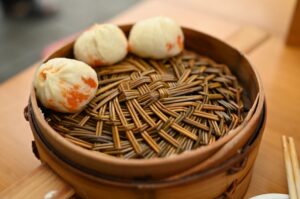
Har Gow (蝦餃 — xiā jiǎo, steamed shrimp dumplings): considered the benchmark of a dim sum restaurant’s quality. The wrapper: translucent, slightly chewy, made from wheat starch and tapioca starch — should have approximately 7 pleats, be thin enough to see the filling, and hold together without breaking. The filling: fresh shrimp, lightly seasoned. A restaurant is judged primarily by its har gow. Siu Mai (燒賣 — shāo mài, open-topped pork and shrimp dumplings): open at the top, filled with pork, shrimp, and water chestnuts, steamed and sometimes topped with fish roe. Cheung Fun (腸粉 — cháng fěn, rice noodle rolls): silky sheets of steamed rice noodle wrapped around various fillings — shrimp, beef, char siu (BBQ pork), or plain (素). Served with sweet soy sauce and sesame. The texture should be extremely delicate. Char Siu Bao (叉燒包 — chā shāo bāo, BBQ pork buns): either baked (glossy, slightly sweet-glazed — baked bao) or steamed (white, pillowy — steamed bao). The steamed version has a natural split at the top when cooked correctly — a sign of quality. Turnip Cake (蘿蔔糕 — luó bo gāo, radish cake): pan-fried cake of daikon radish and rice flour — crispy outside, soft inside. Served with XO sauce or sweet soy. Lo Mai Gai (糯米雞 — nuò mǐ jī, sticky rice in lotus leaf): glutinous rice with chicken, Chinese mushroom, and lap cheong (cured sausage) wrapped in lotus leaf and steamed. One of the most distinctive dim sum dishes. Egg Tart (蛋撻 — dàn tǎ): shortcrust or puff pastry shell with smooth, silky egg custard — the Cantonese-Portuguese fusion dessert. Hong Kong egg tarts use a smooth non-wobbly custard; Macanese egg tarts (influenced by Portuguese pastéis de nata) have a more caramelised top and slightly jiggly custard.