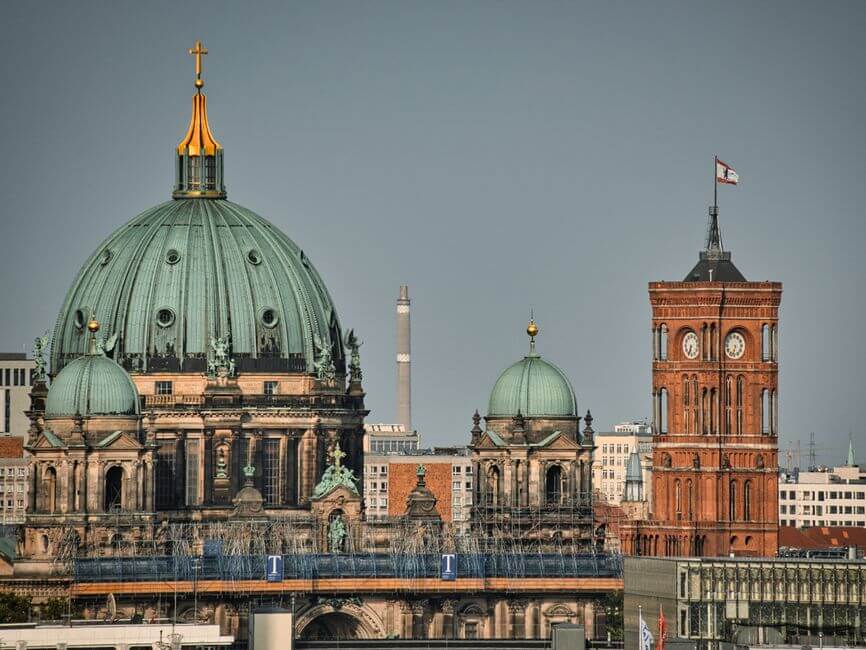
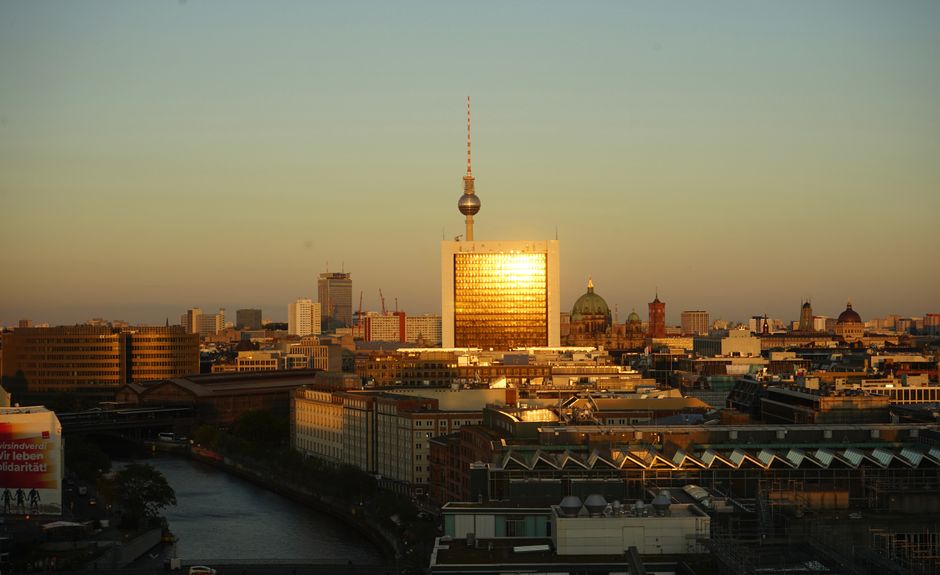
Berlin is Europe’s most historically layered modern capital — a city where the 20th century’s most defining events (the rise of Nazism, Allied bombing, Soviet occupation, the Cold War’s most visible symbol) happened in the same few square kilometres. The physical traces of the Cold War divide remain scattered through the city 35 years after the Wall’s fall in 1989.
The Berlin Wall
The Berlin Wall (Berliner Mauer): built 12–13 August 1961 by the East German government (DDR) to stop the emigration of its own population westwards. Before the Wall, approximately 3.5 million East Germans had left for the West (1949–1961) — the DDR was losing its most educated and productive workers to West Germany’s higher wages and freedoms. Statistics: 155km total length; up to 100m deep “death strip” with armed guards, dogs, and tripwire alarms; 100–200 people killed trying to cross (the exact number is disputed); 5,000+ successful escapes. The fall: 9 November 1989, when a miscommunication by a DDR official at a press conference led him to announce that border crossings could be made “immediately, without delay” — crowds gathered at checkpoints and the guards, lacking orders, eventually opened the gates. The Wall’s current presence: the Wall was almost entirely demolished by enthusiastic Berliners within months of its fall. What remains: the East Side Gallery (1,316m section of the Wall turned into an open-air mural gallery in 1990 — 105 paintings by international artists; the longest remaining section); the Topographie des Terrors (on the site of the former SS and Gestapo headquarters — now an outdoor exhibition documenting Nazi crimes, with a short section of Wall); the Gedenkstätte Berliner Mauer (Berlin Wall Memorial — Bernauer Strasse, 1.4km preserved section with the original death strip, a documentation centre, and a viewing tower); Checkpoint Charlie (the only crossing point between East and West Berlin for foreigners and diplomats during the Cold War — now a tourist site with a reconstructed checkpoint booth, though most of the original is gone).
Cold War Museums
DDR Museum (Karl-Liebknecht-Strasse 1, opposite the Berlin Palace): an interactive museum of life in the German Democratic Republic — touch screens and physical exhibits allow visitors to experience the interior of a Plattenbauwohnung (pre-fabricated apartment block flat), sit in a Trabant car, and understand how surveillance, shortages, and propaganda shaped daily life in the DDR. Entry approximately €12.50. Very popular — book online. The Stasi Museum (Ruschestrasse 103, Lichtenberg — the former headquarters of the Ministerium für Staatssicherheit, the DDR’s secret police): the real offices of the Stasi, preserved as they were on the day the building was stormed by citizens in January 1990. The Stasi had 90,000 full-time employees and 190,000 unofficial informers (Inoffizielle Mitarbeiter, IMs) to spy on 16 million East Germans — one of the highest ratios of surveillance to population in history. The museum shows the surveillance technology, filing systems, and methods used. Hohenschönhausen Prison (Große Hamburger Strasse — the Stasi’s main interrogation prison): tours led by former political prisoners — one of the most powerful memorial experiences in Germany. The Allied Museum (Clayallee 135, Zehlendorf — the former American sector): documents the Allied presence in West Berlin during the Cold War — the airlift (1948–1949), the different lives of West Berliners, and the American, British, French, and Soviet perspectives on the divided city. The Soviet War Memorial in Treptower Park: one of three Soviet war memorials in Berlin — the largest and most dramatic, with a monumental 12m bronze statue of a Red Army soldier holding a German child (and standing on a swastika) designed by Yevgeny Vuchetich in 1949. The Tiergarten memorial (near the Brandenburg Gate) is the most visible but smaller; the Schönholzer Heide memorial in Pankow is the least visited.