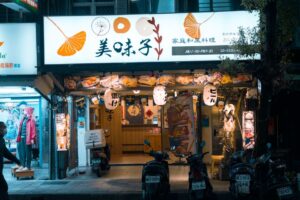
Taiwan has one of the most distinctive food cultures in Asia — a synthesis of Fujianese and Hakka immigrant cooking, Japanese colonial influence (1895–1945), post-1949 mainland Chinese culinary traditions that arrived with Kuomintang troops and refugees, and indigenous Taiwanese ingredients. The result is a food scene that is genuinely unique: night markets that operate nightly, a beef noodle soup tradition considered the finest Chinese-tradition noodle soup in the world by many, and the invention of bubble tea (boba).
The Night Market Culture
Taiwan’s night markets (夜市, yè shì) are open every night — not seasonal festivals but permanent institutions. The major ones: Shilin Night Market (士林夜市, Taipei) — the largest and most famous, operating since the early 20th century; best for oyster vermicelli (蚵仔麵線, ò-á mī-suànn), stinky tofu (臭豆腐, chòu dòufu), and the multiple variations of scallion pancake (蔥抓餅). Raohe Night Market (饒河街夜市, Taipei) — considered by locals to be more authentic and less tourist-heavy than Shilin; the pepper pork buns (胡椒餅, hú jiāo bǐng) from the charcoal-fired oven at the entrance are one of the great Taiwanese street foods. Feng Chia Night Market (逢甲夜市, Taichung) — reportedly the largest night market in Taiwan by area. Liuhe Night Market (六合夜市, Kaohsiung) — the southern capital’s main night market; excellent papaya milk (木瓜牛奶), grilled seafood. The economics: most dishes at night markets cost NT$50–150 (approximately €1.50–4.50). This is food as daily life, not tourist experience — Taiwanese people of all ages eat at night markets regularly. What to order: oyster omelette (蚵仔煎, ô-á-chian) — a southern Fujianese-origin dish where oysters are cooked in a starchy batter and served with sweet-spicy sauce; scallion pancake (葱抓饼); taro balls and sweet potato balls in sweetened soup; iron egg (鐵蛋, tiě dàn) — eggs braised in soy and spices for hours until dark and chewy; peanut ice cream roll in a spring roll wrapper.
Beef Noodle Soup and Bubble Tea
Taiwan beef noodle soup (台灣牛肉麵, táiwān niú ròu miàn): widely considered one of the world’s great noodle soups — braised beef (typically shank or tendon) in a rich, spiced broth with wide wheat noodles. The key components: the broth — a braised stock made with soy sauce, bean paste (豆瓣醬, doubanjiang), star anise, cinnamon, and chillies — cooked for hours until deeply savoury; the noodles — thick, wide, chewy hand-pulled or machine-made wheat noodles; the beef — slow-braised chunks of beef shank and tendon, tender and collagen-rich. The Taipei beef noodle soup history: the dish developed in the 1950s and 1960s when mainland Chinese soldiers and their families arrived in Taiwan with their cooking traditions. Sichuan and Gansu influence is visible in the doubanjiang spicing. The Taipei Beef Noodle Festival (held annually) draws international attention. Bubble tea (珍珠奶茶, zhēn zhū nǎi chá — pearl milk tea): invented in Taiwan in the 1980s (the origin story is disputed between Hanlin Tea Room in Tainan and Chun Shui Tang in Taichung). The essential version: cold black tea shaken with milk and sugar, served over large tapioca pearls (boba) that are chewy and sweet. The modern bubble tea industry has expanded dramatically: cheese foam toppings, tiger stripe caramelised brown sugar boba, fruit teas, brown sugar milk (without tea). The core drink (plain milk tea with tapioca) remains the standard by which Taiwanese shops are judged. Average price at a Taiwanese stand: NT$50–70 (~€1.50–2); the global cafe chains charge dramatically more.